Professional Boxer?: A Title Without a Standard.
One champion. One career fighter. One who never belonged in the ring—and why every state should raise its standards.

What Does “Professional Boxer” Really Mean?
If you are old enough, you remember the golden age of boxing—from the late 1960s through the 1970s and into the early 1980s.
Names like Muhammad Ali, Joe Frazier, Ken Norton, and George Foreman. In the lighter divisions, fighters like Sugar Ray Leonard and Ray “Boom Boom” Mancini. These are the men people think of when they hear the phrase professional boxer.
And that’s exactly the problem.
Because the term itself is technically accurate—but deeply misleading.
In most individual sports, the word “professional” has to be earned. In tennis or golf, you need rankings, qualifications, tour status—proof that you belong. Without that, you may play for money, but no one confuses you with a real professional.
Boxing doesn’t work that way.
In boxing, you pass a physical, get licensed, fight once, and get paid. From that moment forward, you are a professional boxer. The label is real—but it tells you almost nothing about the level of ability behind it.
To see how wide that gap can be, consider three fighters from roughly the same weight class and era: Ray Mancini, Ken Carpenter, and Bill Coleman.
All three were called professional boxers.
But that’s where the similarity ends.. Note: full records highlighted under names.

Ray Mancini was a world champion out of Youngstown, Ohio. His father was a professional boxer whose career was cut short due to injuries sustained in World War II.
Mancini’s father, Lenny Mancini, recognized his son’s ability early and trained him the old-school way, in local gyms, building a foundation from a young age.
In 1979, at age 18, Mancini made his professional debut, knocking out Phil Bowen in the first round. From there, he fought the best in the world, went long rounds under pressure, and proved himself at the highest level of the sport. His record—29 wins, 5 losses, 23 knockouts—reflects a career built against top competition.
When people think of a professional boxer, they are thinking of someone like Mancini.
He is sadly remembered for his 1982 fight with Duk Koo Kim at Caesars Palace, a brutal bout that ended in tragedy. Kim died from injuries sustained in the 14th round. The incident haunted Mancini for years. Kim’s mother later took her own life. Mancini would eventually meet Kim’s son in an attempt at reconciliation—whether it brought peace is known only to them.
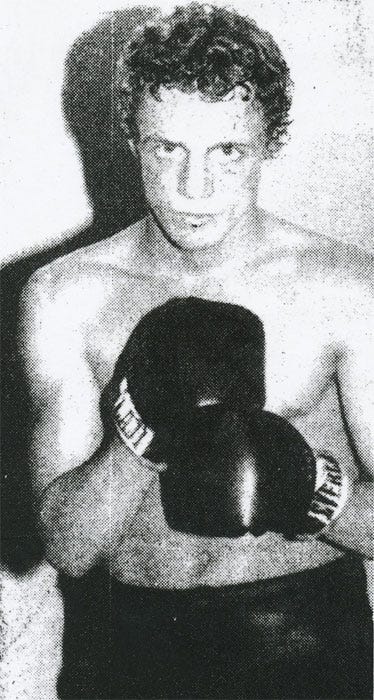
Ken Carpenter wasn’t a champion, but he built a legitimate career. Carpenter was a product of the Upper Darby Police Athletic Leuge in the Upper Darby Boxing Club in Upper Darby, Pennsylvania outside of Philadelphia.
Over roughly six years, he fought 24 times and accumulated more than 100 rounds in the ring. He progressed beyond entry-level four-round fights into six- and eight-round bouts. He fought in real venues—the Philadelphia Spectrum, Atlantic City casinos—and faced experienced opponents, including undefeated fighters.
He took losses, but he was competitive. He went rounds. He belonged in the sport.
That’s what a working professional boxer looks like.
Not famous. Not great. But real.
I knew Kenny growing up, and learned a few years ago that he passed away sometime after 2000.

Then there is Bill Coleman.
In golf terms, he’s not a pro—he’s a 35-handicap player who paid a fee and got on the course.
He was, technically, a professional boxer. He was licensed. He was paid. He fought.
But his career tells a very different story.
He turned professional at age 40, after becoming ineligible to continue as an amateur due to age restrictions. That alone says something: too old to compete as an amateur, but still able to qualify as a professional.
He never fought beyond four-round bouts—the lowest level of the sport. His wins came against fighters making their debut. His losses came against low-level opponents, and they weren’t competitive.
He was dropped multiple times in the first round, stopped early, and in one case was unable to continue against a 1–2 opponent due to a cut.
Even the fighters he lost to were operating at the lowest levels of boxing, often building records against journeymen with heavily losing records.
This is the key point: he wasn’t losing to contenders or prospects. He was getting overwhelmed by fighters who themselves were not particularly good.
All three men were professional boxers.
One proved himself at the highest level.
One built a legitimate career.
One had no business in the ring.
The label is the same.
The reality is not.
Coleman had attempted to get licensed in Nevada—one of the strictest and most respected athletic commissions in boxing—and was denied.
Nevada doesn’t just check whether a fighter can pass a physical. It applies a higher standard. It requires comprehensive medical screening—brain scans, eye exams, bloodwork—and takes a hard look at a fighter’s record, including losses, knockdowns, and stoppages. It also exercises discretion, especially with older fighters or those who show an inability to defend themselves, and it won’t approve obvious mismatches.
Mississippi does not.
That difference is the point.
After being denied in Nevada, Coleman was able to fight elsewhere, in a jurisdiction where the standard is simply whether you meet the minimum requirements.
That’s not unusual in boxing—but it is revealing.
When you look at the full picture—the late start, the lack of progression, and the repeated early knockdowns—you begin to understand why stricter standards exist in the first place.
Compare the standards across states, and the picture becomes clearer. Nevada asks whether a fighter belongs in the ring at all. Ohio (Mancini) and Pennsylvania (Carpenter) take a hard look, especially with older fighters. Other states focus on minimum requirements.
That difference doesn’t just affect licensing—it influences the quality of fighters that come out of those systems.
It’s not a coincidence that the strongest boxing commissions tend to be tied to the strongest boxing markets.