The Powerful Play Goes On
Whitman heard an answer. Springsteen left us searching. What happened to America in between?

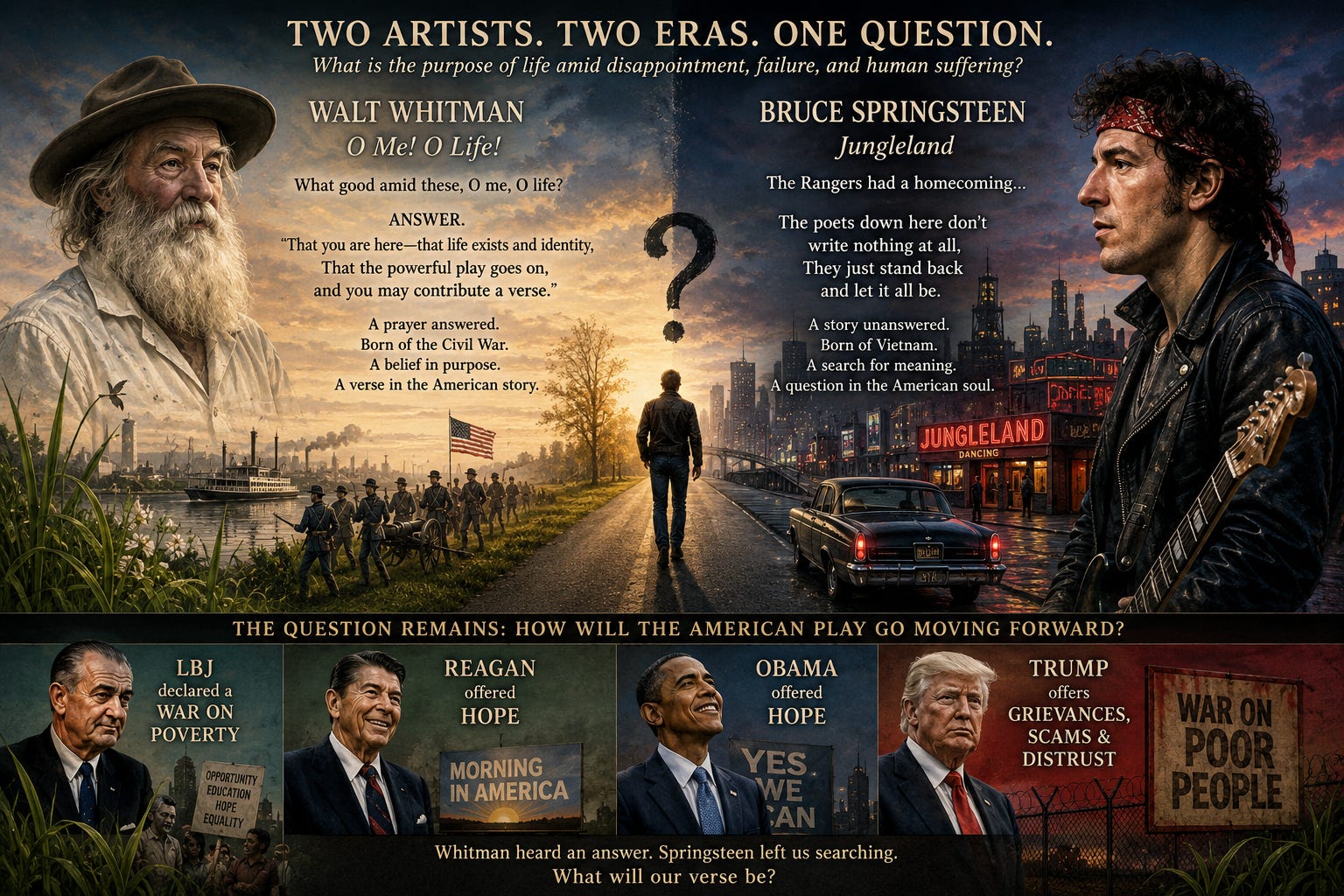
At first glance, Walt Whitman’s O Me! O Life! and Bruce Springsteen’s Jungleland have little in common. One is a fourteen-line poem written in the nineteenth century. The other is a nearly ten-minute rock ballad that concludes the Born to Run album.
Yet both works ask the same timeless question: What is the purpose of life amid disappointment, failure, and human suffering?
More remarkably, both works emerge from defining moments in American history. Whitman wrote during America's transition from the Civil War into Reconstruction and the Second Industrial Revolution, a period marked by extraordinary economic growth, westward expansion, and confidence in the nation's future.
Springsteen wrote in the shadow of the Vietnam War, the decline in manufacturing, rising inflation, and unemployment. The question is the same. The America asking it was very different.
I: Whitman’s Question
Begin with the opening lines of O Me! O Life!.
Whitman surveys a world filled with faithlessness, foolishness, and self-doubt. The poem reads like a prayer. The poem cries out:
“What good amid these, O me, O life?”
Unlike Springsteen's ballad, Whitman does not leave the question unanswered. The poem explicitly provides an “Answer.”
For Whitman, the answer is simple:
“That you are here—that life exists and identity,
That the powerful play goes on, and you may contribute a verse.”
The poem’s power comes from its brevity. Whitman strips the question down to its essence and offers a direct response.
One can even read the poem as a prayer answered by God. Whitman poses the question and then receives an answer from somewhere beyond himself. Whether that voice is divine, democratic, or spiritual, Whitman clearly believes an answer exists.
II: Springsteen Asks the Same Question
Springsteen takes the opposite approach.
Instead of asking the question directly, the album's first seven ballads explore it through characters and stories.
Throughout Born to Run, listeners meet dreamers, wannabe big-time crooks, lovers, musicians, Hot Rodders, and working-class kids searching for something better.
Each song adds another piece to the puzzle.
By the time we reach Jungleland, Springsteen is not asking the question in a few lines. He has spent forty minutes building toward it.
The album itself becomes the question.
If Whitman asks the question in fourteen lines, Springsteen requires an entire album and a ten-minute ballad to explore the same territory.
III: The Difference Between a Poet and a Storyteller
Whitman works like a philosopher.
Springsteen works like a novelist.
Whitman asks:
“What is the meaning of life?”
Springsteen says:
“Let me show you some lives and see what meaning you find.”
One uses abstraction.
The other uses characters, settings, and stories.
One gives us a prayer.
The other gives us a drama.
Whitman embraces brevity. Shakespeare famously wrote that brevity is the soul of wit. Whitman compresses an eternal question into a handful of lines.
Springsteen does the opposite. He unfolds the question through a cast of characters, a sequence of songs, and a final epic narrative. The destination may be similar, but the journey is much different.
IV: Does Springsteen Ever Answer the Question?
This is where the comparison diverges.
Whitman clearly believes there is an answer.
The final stanza is labeled “Answer.”
The poem suggests that existence itself is meaningful because each person has a role to play in the larger drama of life.
Springsteen is less certain.
After nearly ten minutes of struggle, romance, violence, and shattered dreams, Jungleland closes with:
“The poets down here don’t write nothing at all,
They just stand back and let it all be.”
Unlike Whitman, Springsteen never clearly states what the answer is.
The listener is left to decide.
The opening line of Jungleland provides an important clue:
“The Rangers had a homecoming...”
Written in 1973 as American troops were returning from Vietnam, the image of Rangers coming home evokes a nation emerging from a long and divisive war.
Under this reading, the Magic Rat survives the great ordeal only to encounter violence and tragedy at home. The promised redemption never arrives.
Whitman hears an answer.
Springsteen leaves us with a question.
V: Two Americas, One Question
Whitman wrote during a century of expansion, optimism, and democratic idealism.
More importantly, he wrote after the Civil War. Though the war inflicted unimaginable suffering, it also preserved the Union and ended slavery. For Whitman, sacrifice ultimately possessed meaning.
Springsteen wrote in an era of economic uncertainty and fading postwar confidence.
He came of age in the aftermath of Vietnam, Watergate, and growing distrust of institutions. His generation inherited a nation less certain of itself and less confident in grand answers.
Yet both focused on ordinary Americans.
Whitman’s workers, laborers, and ferrymen become Springsteen’s mechanics, factory workers, musicians, and ambitious urban youths.
Both artists believed the lives of ordinary people were worthy of art.
Both transformed local places into universal symbols. Whitman’s ferries, docks, and city streets became poetry. Springsteen’s highways, boardwalks, and backstreets became rock-and-roll mythology.
Conclusion
Whitman needed fourteen lines to ask and answer life’s greatest question.
Springsteen needed an entire album and a ten-minute ballad.
Both begin with the same concern: how do human beings find meaning in a world filled with chaos, disappointment, and uncertainty?
Whitman hears an answer.
Springsteen leaves us searching.
And perhaps that difference tells us as much about the century that separated them as it does about the artists themselves.
Whitman emerged from the Civil War with renewed faith that history possessed meaning and direction.
Springsteen emerged from Vietnam asking whether certainty itself had become impossible.
The question remained the same. America’s answer had changed. Whitman believed every American could contribute a verse to the national story.
Springsteen questioned whether Americans still knew what that story was. Today, the question remains unsettled. Is the powerful play still moving toward a common purpose, or have we become a nation defined more by grievance than aspiration? The answer may determine not only the future of American politics, but whether Whitman's confidence or Springsteen's uncertainty ultimately proves closer to the truth.
Since Whitman’s poem and after Springsteen’s Born to Run album debuted in 1975, Reagan’s “Morning in America” and Obama’s “Hope” campaign were both attempts to tell Americans that the future could and would be better than the present.
Then contrast that with Trump, whose political message is centered on grievance, decline, betrayal, and distrust. His rhetoric frequently identifies enemies—immigrants, elites, the media, political opponents, government institutions—rather than inviting Americans into a shared national project.
Lyndon Johnson declared a war on poverty; Trump, has declared a war on poor people.